Patient Repositioning at the Push of a Button

The EasyBoost Repositioning System is a pneumatic hardware retrofit that is attached to the hospital bed. EasyBoost Cushion attaches to EasyBoostSheet and inflates to boost the patient up the bed. The system uses pneumatics instead of AC power near the patient.

EasyBoost Device components

EasyBoost Sheet Options

Disposable Sheet SKU:  ESB–DIS–2027 (Box of 12)

Safe Working Load:  800 lbs (Boosting), 650 lbs (Lateral Rotation)
Sheet is not rated for hoisting or out-of-bed transfer

Launderable Sheet SKU: ESB–RES–2029 (Box of 12)

Safe Working Load:  500 lbs (Boosting and Lateral Rotation)

Service Life for Sheet:  100 laundry cycles (chlorine bleach not recommended due to discoloration)

EasyBoost Device Specifications

Standard Unit:  ESB–400 (400 lbs capacity)

Bariatric Unit:  ESB–800 (800 lbs capacity for boosting, lift loops rated for 650 lbs)

Electrical Compliance:

  • ANSI/AAMI ES60601-1:2005/(R)2012
  • CAN/CSA C22.2 No. 60601-1-14 (2018)
  • IEC 60601-2-52 (2015)
  • IEC 60601-1-6 Edition 3.1 (2013)

Download EasyBoost Brochure

Download

Third Party Breathability Data

Download

Download Pressure Mapping Brochure

Every Angle Counts:

Boosting Patients with Respiratory Insufficiency

By Jimbo Varnum, RRT-NPS-ACCS, CSPHA and Samuel Fox, BSE

For many critically ill patients, clinical practice guidelines recommend elevating the head of the bed to 30–45° whenever feasible (AACN, 2016; Chan et al., 2024).

Patients receiving mechanical ventilation or enteral feedings are at increased risk of gastroesophageal reflux and aspiration of gastric contents, which can precipitate ventilator-associated pneumonia and other respiratory complications (American Association of Critical-Care Nurses [AACN], 2016).

This semi-recumbent position of 30–45° also improves lung mechanics and oxygenation in many critically ill patients, including those with acute respiratory distress syndrome (ARDS) (Duggal et al., 2024).

However, this semi-recumbent position makes boosting these patients up in bed more challenging for caregivers. Standard nursing procedure is to place the bed flat to provide a gravity assist for the caregivers. Most assistive repositioning devices, such as slide sheets or air-assist devices, require the bed to be flat to operate effectively.

With EasyBoost Repositioning System, the patient can be boosted at a 30° angle without placing the bed flat.

TRANSPARENT_Figures for Every Angle Counts
Figures for Pressure Redistribution

How EasyBoost Supports Pressure Redistribution

By Erica Thibault, MS RN CNS APN CWON and Samuel Fox, BSE

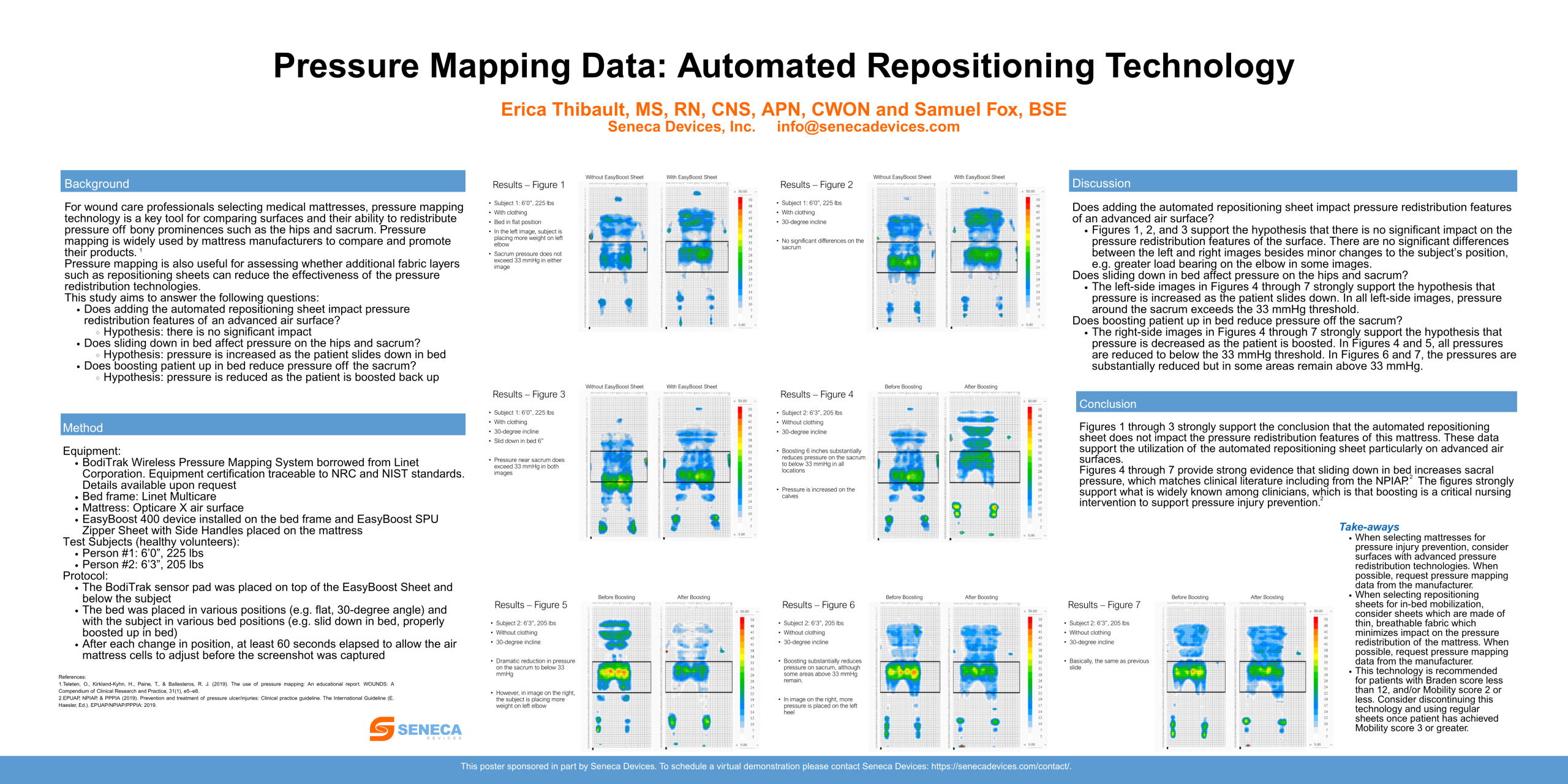
While there are many benefits of maintaining the head-of-bed at 30–45°, this causes the patient to slide down in bed over time.

The further the patient slides, the greater the pressure on the hips and sacrum (Figure 3), which is a key risk factor for development of pressure injuries.

Pressure mapping technology – such as the BodiTrak system used to create these images – illustrates how pressure can become concentrated on certain bony prominences such as the hips and sacrum.

As seen in Figure D, repositioning with EasyBoost helps redistributes pressure off the sacrum. Repositioning also aligns the patient’s hips with the “hip zone” of the mattress, which typically contains the most advanced pressure redistribution features of the mattress.

Download Pressure Mapping Data

Keeping Cool:

Selecting a Breathable Repositioning Sheet

By Erica Thibault, MS RN CNS APN CWON and Samuel Fox, BSE

For patients at risk of skin breakdown, managing heat, moisture, and shear are critical to preventing pressure injuries (EPUAP, NPIAP, & PPPIA, 2019). Advanced air support surfaces are designed with microclimate management to draw heat and moisture away from the patient’s skin, and with immersion and envelopment features to redistribute pressure.

However, mobilizing and repositioning patients can be challenging on such air surfaces, with caregivers particularly at risk of back and shoulder injuries, which comprise 71% of all healthcare worker’s compensation claims (Bureau of Labor Statistics, 2018).

Repositioning sheets are frequently used to facilitate in-bed mobilization, but the additional fabric layers can impede the ability of the air surface to draw heat and moisture away from the skin. Selecting a repositioning sheet with high evaporative capacity is critical to maximizing the effect of advanced air surfaces. This third-party study evaluates four types of repositioning sheets on an advanced air surface, following standardized S3I protocols to measure evaporative capacity.

Keeping Cool Thumbnail #2

Download S3I Breathability Test Report

Download

Frequently Asked Questions

General

What is the maximum weight capacity for EasyBoost?

Standard Unit:  ESB 400 (400 lbs capacity)

Bariatric Unit:  ESB 800 (800 lbs capacity)

What is the width and weight capacity of the EasyBoost Sheet? Can it be laundered?

Disposable Sheet:
SKU: ESB-DIS-2027, Case of 12

  • Handles 40″ apart, total sheet 66″
  • Can be used until visibly soiled
  • 800 lbs capacity for boosting
  • 650 lbs capacity for lateral rotation

Launderable Sheet:
SKU:  ESB-RES-2029, Case of 12

  • Handles 40″ apart, total sheet 66″
  • Up to 100 washes
  • 500 lbs capacity for boosting
  • 500 lbs capacity for lateral rotation

What angle can the head-of-bed be during boosting?

0° – 30°. While the device can work up to 45°, this may reduce the maximum weight capacity. On many
bed frames, the head-of-bed angle needs to be at least 10° to provide room for the device to expand.
Seneca installs a sensor on the frame which stops the motor if the bed angle is too low.

Is the EasyBoost Sheet compatible with low-air-loss mattresses?

The EasyBoost Sheet is highly breathable and has been independently tested following S3I “sweating hot plate”
protocols. Download the white paper here: EasyBoost Sheet Breathability Data

The EasyBoost SPU Sheet is 30% more breathable than the leading repositioning sheet on the market:

Evaporative Capacity

How do you clean the EasyBoost device?

The blue cushion and straps have been tested for use with CloroxPro, CavaCide, and Virex Tb. To check
compatibility with your facility’s cleaning chemicals, please contact info@senecadevices.com.

What kind of bed frames can EasyBoost attach to?

EasyBoost is compatible with the vast majority of hospital and long-term care bed frames. There are only a small number of specialty beds which are not compatible. To check if your bed is compatible, please contact info@senecadevices.com.

Can EasyBoost be moved from bed to bed?

The major EasyBoost subassemblies are modular and can be moved between beds. Seneca recommends installing the base components (installation straps, control unit, etc) on every bed which may require the device. The inflatable cushion and other components can then be moved from bed to bed based on patient census.

Does EasyBoost require modifications to the mattress?

EasyBoost is completely separate from the mattress and requires zero modifications to the surface.

Is EasyBoost certified to IEC 60601-1?

Electrical Compliance

ANSI/AAMI ES60601-1:2005/(R) 2012
CAN/CSA C22.2 No. 60601-1-14 (2018)
IC 60601-2-52 (2015)
IEC 60601-1-6 Edition 3.1(2013)